Global Business and Economics
Faculty of Economics and Business Administration





- Introduction
- Key Features
- Field of Study
- Curriculum
Build Future-Ready Skills for a Changing Business World
KUAS Biz, the Global Business and Economics Program is designed to help students develop practical skills that can drive innovation in business and contribute positively to society. The curriculum covers a broad range of subjects—from essential foundations such as microeconomics, accounting, management, and marketing to contemporary fields including data science and cross-cultural communication.
The program is supported by a diverse faculty team, many of whom have held executive and leadership positions in top global companies. Students gain insight not only from academic theory but also from the real-world expertise of seasoned professionals, giving them a strong competitive edge when pursuing careers across various industries.
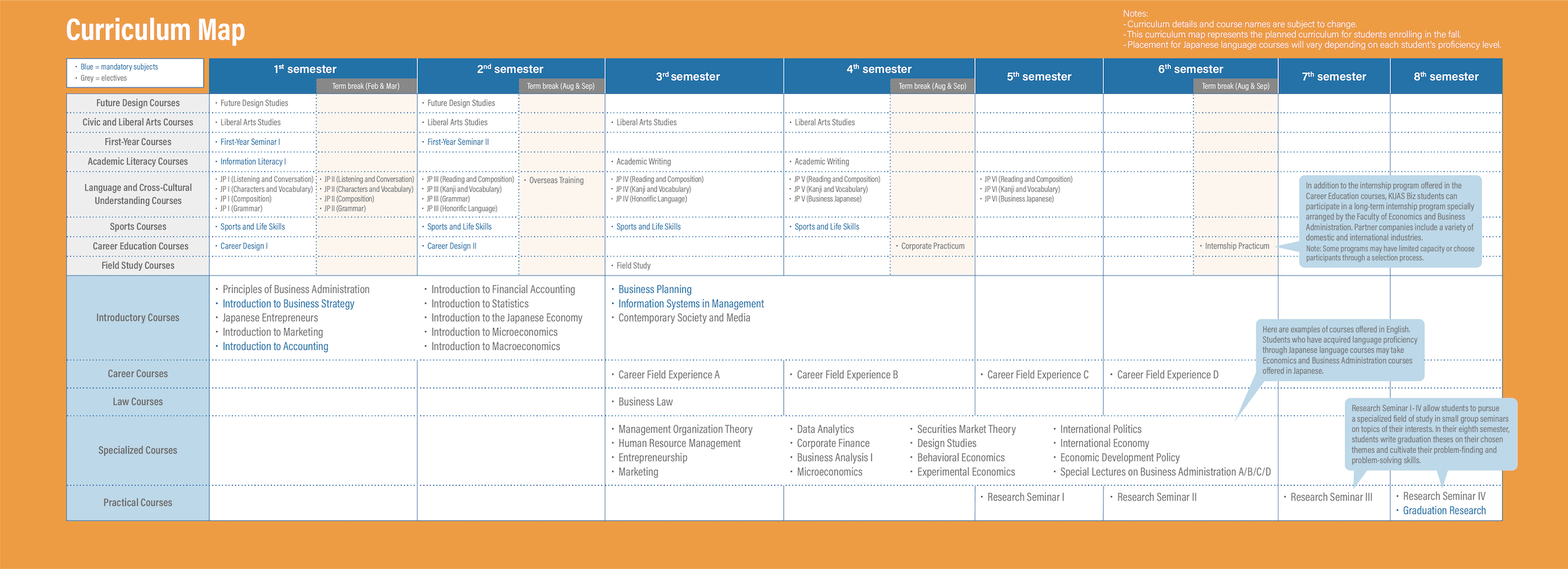
During the first and second years, students focus on liberal arts, information literacy, Japanese language, and introductory courses in business and economics. All classes, except for Japanese language courses, are taught entirely in English, creating an accessible and supportive learning environment for international students.
In the third and fourth years, students can participate in exclusive internship programs, take advanced specialized courses, or join seminars where they conduct research on topics of their choice.
They may also choose to take specialized courses offered in Japanese. Because both Japanese and international students take part in these classes, they become an active space for meaningful cross-cultural exchange and global collaboration.
Curriculum Overview
KUAS’ curriculum is designed to help students confidently plan their future pathways by providing a career-ready balance of Liberal Arts Courses and Specialized Courses in each academic department. Through this combination, students develop both international and social literacy while building the knowledge and skills needed for their chosen fields.
Liberal Arts Courses
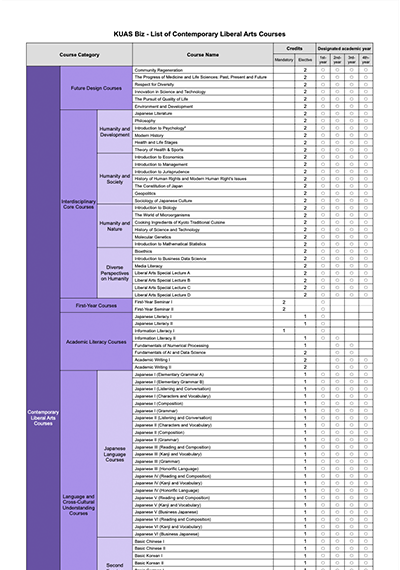
Liberal Arts Courses provide a diverse range of education that fosters essential skills for engaged participation in society. These include foundational subjects that strengthen literacy and language abilities, as well as courses related to sports, culture, and career development—allowing students to broaden their perspectives in multiple directions. As Liberal Arts Courses bring together students from various faculties and nationalities, they are offered not only in English but also in Japanese. Gaining basic Japanese proficiency and taking Japanese-taught courses can be highly valuable for deepening intercultural understanding and improving communication skills.
Specialized Courses
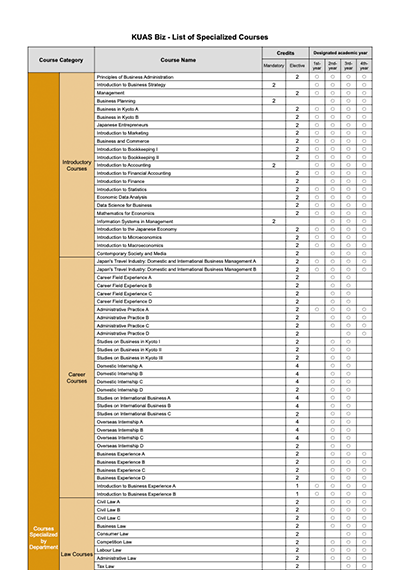
Each department offers a structured set of specialized courses that allow students to build professional skills systematically and across disciplines—from basic theories to applied and experience-based hands-on training. Students can freely choose specialized courses aligned with their interests and career goals, enabling them to develop both expertise and technical competence.
Specialized courses in the Global Business and Economics Program are generally conducted in English; however, the language of instruction may change to Japanese depending on the academic year. Please check the course information at the time of registration to confirm the language in which each course will be offered.
In addition, students in the Global Business and Economics Program may also take courses offered in Japanese by the Department of Economics if they wish. Please note that some courses have specific enrollment requirements. For details, please confirm the information during course registration.
Curriculum Map (Click to enlarge)
Course Lists
Curriculum Structure
Specialized courses in the Global Business and Economics Program are organized into five categories: Introductory Courses, Intermediate Courses, Seminar Courses, Career Courses, and Law Courses. Through the Career and Law Courses, students develop essential knowledge and skills common to the broader field of social sciences. Meanwhile, the Introductory, Intermediate, and Seminar Courses foster independent thinking and problem-solving abilities grounded in the diverse and specialized areas of business administration.
An overview of the coursework for each academic year is provided below.
First Year
Students take Introductory Courses to build foundational knowledge in business administration and to understand the purpose and significance of the field. Courses include Introduction to Accounting, Business and Commerce, Introduction to Business Strategy, Introduction to Bookkeeping I, and Principles of Business Administration.
Second Year
Students begin taking Career Courses, Law Courses, and Intermediate Courses, where they develop problem-solving skills through more advanced theories in business administration. They also cultivate the basic competencies required of working professionals through subjects such as Business Planning, Information Systems in Management, Career Field Experience, and Practical Training for Career Development.
Third Year
Students enter small-group Seminar Courses in specialized areas of business administration based on their interests. At the same time, they continue career-oriented practical learning and take intermediate-level courses with enhanced academic focus. They also begin structured research activities in preparation for their graduation thesis.
Fourth Year
Under the supervision of their seminar advisor, students conduct Graduation Research on a topic of their choosing. Through this culminating project, they strengthen their ability to identify and solve problems in business administration. Successful completion of Graduation Research is a requirement for graduation.
Academic Degree and Graduation Requirements
- Academic Degree: Bachelor of Business Administration
- Duration of Study: 4 years (8 semesters)
- Required Credits: 124 credits in total (50 credits from Liberal Arts Courses, 74 credits from Specialized Courses)