


Interdisciplinary Education for a Complex and Connected World
Dec 25, 2025

In an era marked by rapid technological change and increasingly complex global challenges, universities are being asked to reconsider how knowledge should be taught and applied. Issues such as environmental degradation, resource scarcity, and economic inequality do not exist in isolation. Rather, they are deeply interconnected, requiring solutions that extend beyond the boundaries of any single academic discipline.
This growing complexity has brought renewed attention to interdisciplinary education.
Historically, many groundbreaking discoveries emerged from scholars who worked across multiple fields. Figures often described as polymaths—including Leonardo da Vinci, Isaac Newton, and Charles Darwin—advanced human knowledge by integrating ideas from different disciplines. At a time when scientific knowledge was more limited in scope, it was possible for individuals to pursue and master several fields simultaneously.
By contrast, modern higher education has developed around increasing specialization. Universities have traditionally emphasized depth within narrowly defined majors, reflecting the expansion and sophistication of each academic field. While specialization remains essential, this model alone is no longer sufficient to address the challenges of contemporary society.
Many of today’s most pressing global issues cannot be solved through a single disciplinary lens. Environmental problems are linked to technological development, economic systems, and social behavior. Advances in technology raise ethical, legal, and sustainability questions. Business decisions are influenced by economic policy, data science, and cultural contexts.
As a result, there is growing recognition of the importance of problem identification and problem-solving skills that draw on multiple perspectives. Interdisciplinary education responds to this need by equipping students with the ability to integrate knowledge, think critically across domains, and apply theory to real-world situations.
Reflecting this shift, the future of higher education is increasingly oriented toward interdisciplinary and multidisciplinary learning models.
KUAS’ all-English degree programs are designed with this educational transformation in mind.
KUAS Eng’s Multidisciplinary Program

The Faculty of Engineering at KUAS offers a distinctive educational structure. Rather than being divided into multiple departments, it consists of a single department: Mechanical and Electrical Systems Engineering. Within this unified framework, students engage with a broad range of fields, including nanomechanics, robotics, electronics, computing, information and communication technologies, and system design.
This interdisciplinary integration enables students to understand how different technological domains interact. For example, the development of IoT systems requires expertise in data acquisition through sensors, system-level data analysis and control, materials science for energy efficiency, and optimized energy use. Addressing such challenges demands knowledge that spans traditional disciplinary boundaries.
KUAS Eng provides a multidisciplinary program that allows students to combine specialized subjects according to their interests and academic goals. This flexible structure supports autonomous learning and intellectual exploration. Students apply their knowledge through hands-on experiences such as Mechatronics Laboratories, as well as Project-Based Learning (PBL) initiatives, including Keystone and Capstone Projects conducted in collaboration with industry partners.
Through teamwork, discussion, and iterative experimentation, students develop skills that are essential in professional engineering environments. The curriculum is designed as a structured pathway that supports students’ transition from academic study to real-world practice.
KUAS Bio’s Cross-curricular Program

In 2025, KUAS reorganized the Faculty of Bioenvironmental Sciences to better reflect the interconnected nature of life, environment, and food systems. The faculty now consists of two integrated departments: Environmental and Bioresource Sciences and Applied Biological Sciences. This reorganization was guided by a mission to promote sustainable environments in which humans and diverse living organisms can coexist.
While grounded in four core themes—environment, agriculture, food, and life—the faculty encompasses a wide range of specialized fields and 30 research laboratories. Research topics range from molecular and cellular studies to investigations of microorganisms, plants, insects, food systems, and global environmental challenges.
Students enroll in one department while retaining the flexibility to take specialized courses offered by the other. Through this cross-curricular program, they develop an understanding of how natural phenomena are closely interrelated. For instance, addressing marine plastic pollution requires biological and ecological research to assess environmental impact, as well as chemical and materials engineering expertise to develop sustainable alternatives.
The faculty’s location in a rich natural environment further supports experiential learning. Fieldwork and laboratory experiments complement each other, allowing students to connect theory with observation and practice. Capstone research projects extend this approach by offering opportunities for collaboration with other faculties, external research institutions, and industry partners.
By engaging with diverse perspectives, students gain insights that extend beyond individual disciplines and research laboratories.
KUAS Biz’s Dual-faceted Program
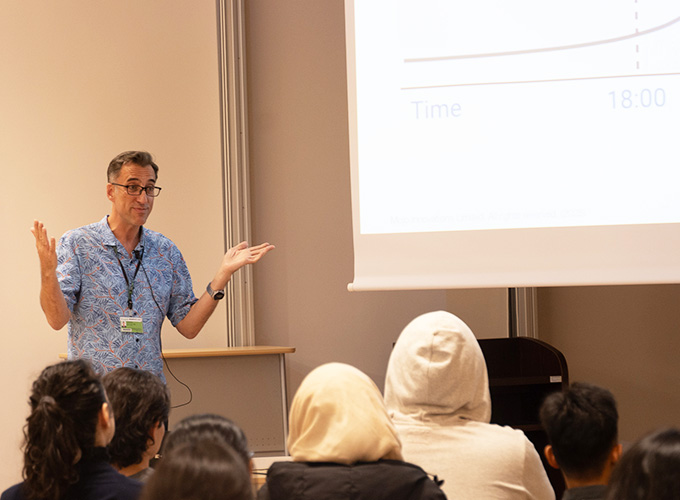
The Global Business and Economics Program, launched in 2025, reflects KUAS Biz’s interdisciplinary approach within the social sciences. Designed for students from around the world, the program integrates economics and management in a dual-faceted curriculum.
Economics provides tools for analyzing markets, institutions, and public policy at a macro level, while management focuses on organizational behavior, strategy, and decision-making at the firm level. By combining these perspectives, students learn to translate economic analysis into practical business strategies and to design sustainable business models.
The program offers a wide range of courses, including data science, accounting, finance, and quantitative analysis, alongside applied subjects such as marketing, design, and entrepreneurship. Practical learning is reinforced through case studies led by experienced professionals and collaborative capstone projects with partner companies.
This integrated approach prepares students to navigate complex global business environments with flexibility and analytical rigor.
Interdisciplinary Learning and Future Career Pathways
Interdisciplinary education provides a foundation for diverse and evolving career pathways. By engaging with multiple fields of study, students learn to question assumptions, identify overlooked issues, and develop innovative solutions. Collaborative learning with peers from different academic backgrounds also fosters intercultural understanding and teamwork skills.
At KUAS, students from diverse countries and disciplines form a dynamic learning community that encourages exploration beyond traditional academic boundaries. This environment supports the development of individuals capable of contributing to new technologies, services, and business models that address future societal needs.
Through interdisciplinary education, KUAS aims to cultivate Borderless Innovators—graduates who can create new value and contribute meaningfully to an increasingly interconnected world.